
By Cailin Riley – Southampton Press
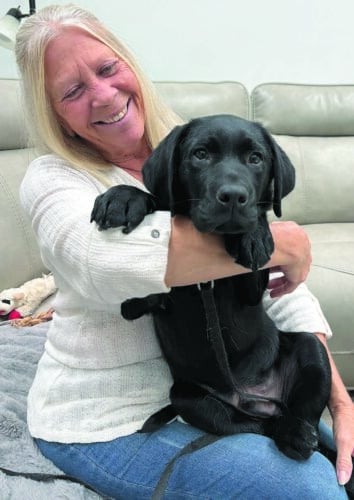
Life threw Dorothy Marino a curveball in the beginning of 2022.
She lost her husband, Philip, unexpectedly, and she wasn’t sure what was next. Plans they’d had together to travel were suddenly irrelevant, and she was alone. It was at her husband’s wake that a friend made a suggestion that showed Marino a way to forward through her grief.
“A couple of people were, like, are you going to get a dog now?” Marino recalled, sitting on the leather sectional in the living room of her Hampton Bays home earlier this week. “One of our friends who was there said to me, ‘Have you thought about either fostering or raising a puppy for Canine Companions?’ I’d never heard of them, but he said, ‘Look into it.’”
As Marino spoke about that pivotal moment in her life, nearly four years ago, a 12-week-old black lab puppy named Jabba was curled up on the corner of her sectional, chin on the armrest, fast asleep. He’s been with Marino for four weeks and will stay in her home until he’s around 14 to 16 months old.
Jabba is the third puppy that Marino has raised for Canine Companions, a national nonprofit that breeds, trains and places service dogs that enhance the independence of people with disabilities. The organization was founded in 1975 and is the largest nonprofit provider of service dogs in the country.
Canine Companion dogs assist people with a wide range of disabilities, including multiple sclerosis, cerebral palsy, spinal cord injury, stroke, hearing loss, developmental delay, veterans with post-traumatic stress disorder and more.
The organization does not charge for the dogs or the lifetime of support the organization provides. It relies on a network of volunteer puppy raisers, like Marino to provide the basic training that the dogs need when they are young, before they are handed over for professional training.
Only about half of the dogs that go through professional training graduate and become certified Canine Companions service dogs. Those who do not move on are always found loving homes — with their puppy raiser earning the right of first refusal.
Jabba is one of three dogs living with Marino at the moment. Her first Canine Companions puppy, a now-3-year-old yellow lab named Vesta, did not make the cut.
In a way, it seemed like fate.
Vesta was the first puppy that Marino took on, in September 2022, less than a year after her husband died.
“They really decide what they want to do,” Marino said of Vesta. “You can’t force them to be a service dog. You can do everything right, and then, with a dog like Vesta, she’s still a puppy — she just wants to play. But she comforted me so much. She’s where she was meant to be.”
It sounds like Marino is, too. She has high praise for the Canine Companions organization and in particular the way it supports all the volunteers in its network.
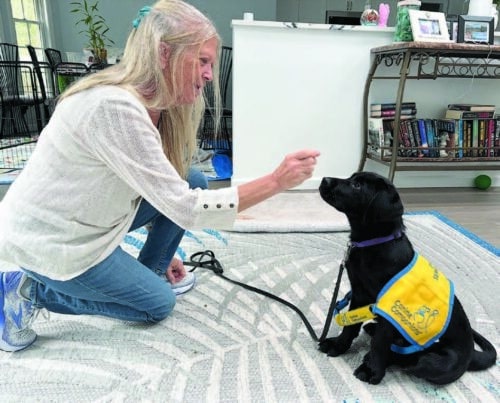
Hampton Bays resident Dorothy Marino and Jabba perform basic obedience training, which is part of the job of a puppy raiser.
When Marino was raising her second puppy, Ravioli, she came down with a spinal infection that made it hard for her to care for Ravioli and provide the training he needed.
“The people in the Long Island Volunteer Chapter are amazing,” she said. “Everybody just stepped up. Three different people took three different dogs. It was just an amazing feeling to know that they’re there for you. And they stay with you.”
Marino had plenty of experience training dogs and doing obedience training before she became
a puppy raiser. She and Philip had many dogs over the years that she trained, which made her a great fit for the role. But experience in obedience training isn’t a prerequisite.
Marino explained that staff from Canine Companions are always available for any questions puppy raisers may have about the details of training. Puppy raisers also go to sessions twice monthly with professional trainers from the organization at its nearest headquarters, in Medford, to make their training skills sharp.
Even with that support, training a puppy isn’t easy. Marino puts in a lot of time and effort with Jabba, and with the dogs she’s had before. But she said it’s well worth it, for a variety of reasons.
She knows, maybe better than most, all the ways a dog can enhance someone’s life, whether it’s enhancing independence, quelling anxiety, or helping someone manage grief.
Marino not only lost her husband unexpectedly a few years ago. She lost her son when he was just 15 years old, hit by a drunk driver on the same street she lives on, in 2009.
“I’m not the only one who’s gone through grief,” she said. Having these dogs, it gives you a reason to get up in the morning. Any dog will do that for you, but this goes beyond that.” Marino rattled off a list of skills that puppy raisers must help their charges master in a little over a year — stand, drop, give, heel, side, jump, kennel. They must learn how to sit still and in the right position for their trainer to put the Canine Companions vest on, as well as the gentle leader leash.
Kim Doyle is a senior instructor with Canine Companions, and got her start with the organization as a puppy raiser. She spoke about how vital people like Marino are to the success of the organization. “Volunteers like Dorothy are so important, because individuals who have disabilities are waiting for two years to be placed with a service dog from our organization,” she said. “While it is free of charge, the numbers of puppies can only be produced if we have the puppy raisers to raise them. “The mission is important, because it gives people with disabilities greater independence on a daily basis. Those who have physical limitations are given the ease to not have to use their strength to pick something up off the ground or opening a heavy door when they have their service dog to be able to perform those tasks for them. The individual can have more stamina to do their daily tasks and also have an amazing companion at their side while doing so.”
That’s the knowledge that keeps Marino coming back for more puppies, even though she admits it’s never easy when it’s time to let them go.
“We are really in need of more puppy raisers on Long Island,” she said. “And you do hear the same thing all the time: ‘How can you give them up?’ The only thing you can do is keep telling yourself that they were never mine to being with. And you’re doing this so that, hopefully, someone else can live a more independent life.”
For more information on Canine Companions, including how to volunteer to be a puppy raiser or foster, visit canine.org.