
By Chris Francescani – North Fork Sun
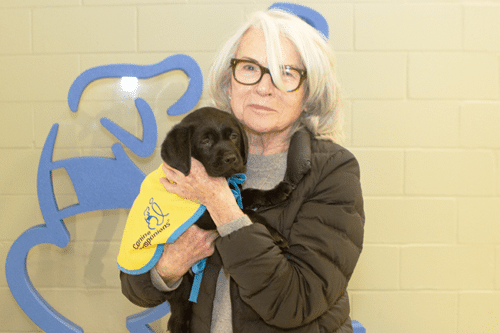
Three and a half years ago, after her husband’s death, Eileen Lederer moved to Greenport seeking something intangible. That search eventually led her to become a service dog puppy trainer.
“I needed a purpose,” she said in an interview this week.
She had already looked into volunteer opportunities, but “I just didn’t find a suit for me at all.”
Her daughter emailed her a link to Canine Companions, the national nonprofit that raises and trains service dogs for people with disabilities, and Lederer was sold.
At an age when many retirees are slowing down, she signed on to a significant commitment: becoming a “puppy raiser” for the first time, taking in an 8-week-old black Lab named Smiley at the start of a rigorous process of training her for a life of service.
“It’s a lot of work, but it’s a lot of fun,” said Lederer (pictured above, with Smiley, who turned 8 weeks old on March 4).
Smiley is still a baby, but Lederer is impressed.
“She’s very smart,” she said, and already “very good with the house training, very good with ‘sit.’”
She has to be. She’s being raised to do a vital job.
”Puppy Raisers’
Puppy raisers like Lederer are an essential part the process for Canine Companions, a national nonprofit whose Northeast training center headquarters are in Medford.
The organization trains service dogs for adults, children and veterans with disabilities, and trains facility dogs for professionals working in healthcare, criminal justice and education. While puppy raisers foot the bills while the dog is with them, Canine Companions pay for everything else — which can be up to $50,000 over the life of the dog. The recipients pay nothing.
Kim Doyle, a Long Island-based senior instructor with the organization, said the volunteers take the dogs in at about 8 weeks old and keep them until they are roughly 16 months old. During that time, raisers handle toilet training, crate training, socialization, house manners and getting the dogs comfortable in all kinds of public settings.
“The puppy raiser puts on maybe 15 to 20 skills on the dog,” Doyle said. The more advanced service work comes later, during six months of professional training in Medford, where the dogs learn dozens of more complex tasks, including picking up dropped items and tugging open doors.
Doyle said professional trainers like herself depend on the puppy raisers to do something they can’t replicate in a training center.
“The professional trainers can’t bring them into public as much, or cuddle on the couch with them, or play ball with them every day, one on one,” Doyle said. “So that’s what we rely on most for our puppy raisers to do.”
Lederer is new to service dog puppy raising, but has had six pet dogs: four collies and two black Labs. With Smiley, “the training is different,” she said. “The commands are different, and there are a lot of commands that they have to learn if they’re ever going to be service dogs.”
She seemed energized by the opportunity.
“It’s a learning experience for me too, one that I’m willing to take the challenge and do.”
But she knows black Labs.
“They’re high-energy and they are food-motivated,” she said, making them eager workers.
Lederer said she knows giving Smiley up “will probably be quite difficult.
“But she’s not my dog. The purpose will be fulfilled, for all of us, if she makes it.”
If Smiley runs the pro training gauntlet and is ultimately placed with a disabled recipient, Lederer would love to meet that person.
“That would be the icing on the cake.”
Puppy raisers receive monthly updates while the dogs are in professional training, and if the dogs graduate, the raisers are invited back for a ceremony where they meet the recipient and hand over the dog’s leash onstage.
Some of those bonds last for years.
Doyle, a veteran puppy raiser herself, said she still texts weekly with the family of one dog she raised that was placed in Texas. She and her husband made a point of stopping to visit that dog during their honeymoon road trip.
In another case, a dog she raised was placed with a teenage boy with severe physical disabilities, and the relationship between puppy raiser and recipient grew so close that he asked her to his prom.
For more information on Canine Companions, including how to volunteer to be a puppy raiser or foster, visit canine.org.