

Who would have predicted that responding to a PennySaver ad for volunteer office work would lead to a 36-year-long fulfilling career?
In the 1980s, Ellen Torop earned a master’s degree in behavioral evolution, studied at the Institute of Animal Behavior and grew particularly fascinated by dogs.
“I was fascinated by dog behavior, by the fact that people and dogs can actually have a dialogue and understand one another, because we are so different,” reflected Torop. “Because of that interest, I was well aware of Canine Companions.”
Canine Companions is the present-day national leader of the service dog industry. The nonprofit organization organizes the breeding, raising, training, and pairing of service dogs, skilled companion dogs, facility dogs and hearing dogs to people with varying needs.
At the time, Canine Companions already had a handful of campuses established throughout the country, but in New York, there was only a minuscule satellite office operating from a trailer in SUNY Farmingdale.
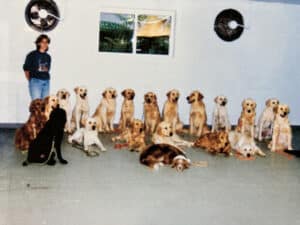
When nonprofit organization Canine Companions opened its first kennel in New York 36 years ago, Ellen Torop was the first hire.
A friend of Torop’s that lived on Long Island saw in the PennySaver that Canine Companions was looking for volunteers and alerted Torop, who began commuting from Brooklyn to volunteer.
Six months later, when the organization began building a kennel and hiring, Torop was the first hire.
Torop is now retiring as the Northeast Region Program Director of Canine Companions, leaving behind a 36-year-long career distinguished by success, humility and impact on the service dog industry.
Torop was the architect of numerous programs and oversaw the selection, training, placement and follow up of service dogs for people with disabilities other than blindness.
Torop helped design multiple facilities for the organization, including the Northeast Region’s state-of-the-art training center in Medford. The center features 35 kennels, five training rooms, Bogie’s Bistro (a community space with an accessible kitchen and dining room), and 11 spacious fully handicapped accessible dorm rooms for training participants and their families.
Prior to Torop’s design of the dorms, students coming from all over the Northeast would stay in local hotels. In addition to the financial expense, students had fewer opportunities to bond and support one another during classes.
“Now, here with the dormitory, they stay on site, connect with each other and form lifelong friendships. It is a totally different experience for them,” Torop explained. “Very often they are the minority in the world, and very often they go to places that are not accessible to them. In the dorms, they are able to be in a place where they are the majority, in a situation that caters to their needs, is fully accessible and filled with people in the same situation.”
Torop more recently spearheaded the development of the therapy-dog program. Not all dogs bred and raised in the Canine Companions program are selected to be placed with people on the nonprofit’s waiting list. Sometimes a very trivial thing will stop a dog from being able to work in public as a service dog. In the past, those dogs would often go back to live with their puppy raisers.
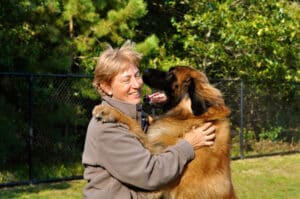
Torop is pictured along her own dog, Ru.
“We started a therapy dog program fairly recently, which allows those dogs that were raised for us but just did not make the cut to still go out and help populations of people,” Torop explained. “Yes, they do not have as complex tasks, but they are wonderful dogs and bring a lot of joy to people in a lot of different facilities. They make a tremendous impact.”
Perhaps the most fulfilling aspect of Torop’s career has been hearing stories from handlers about the way their service dog changed their life. Months, or even years after a pair graduates, Torop would receive a phone call, email or photo describing something a dog did that elucidates the impact the dog is having on their handler’s life. Sometimes it is a simple situation, explains Torop; a person using a wheelchair is in a parking lot at night in the rain, getting to their van, and they drop their keys. If they were alone, they would be sitting there in the rain, in the dark, until someone came and helped them because they cannot bend down in their wheelchair to get the keys. But with the dog there, the dog immediately retrieved them, and the pair were on their way.
“Something that we do not really think about, something simple like that, enables a person to have the confidence to go out on their own. That is what independence is,” said Torop. “We take it for granted, but some people feel like they cannot do that. It is moments like that that are the most gratifying.”
While Torop now begins her retirement, she will continue to see her impact grow on the Canine Companions Northeast Training Facility. To help tackle the ever-growing waitlist of people in need of a Canine Companions dog, Torop designed a dormitory and kennel expansion, which will allow for bigger classes, ultimately assisting more people.
In her retirement, Torop looks forward to traveling, continuing to train her own dogs, becoming more involved in the old-time Appalachian music scene and reflecting on the career of a lifetime.
“I have an incredible amount of gratitude and I consider myself really lucky that I had an opportunity to find something that I am passionate about that also has an impact,” noted Torop. “I know a lot of people do not have that chance in their lives or their careers, so I have a lot of gratitude.”
For more information about Canine Companions, visit canine.org.