
Therapy Dogs

Learn more about our therapy dog certification program.

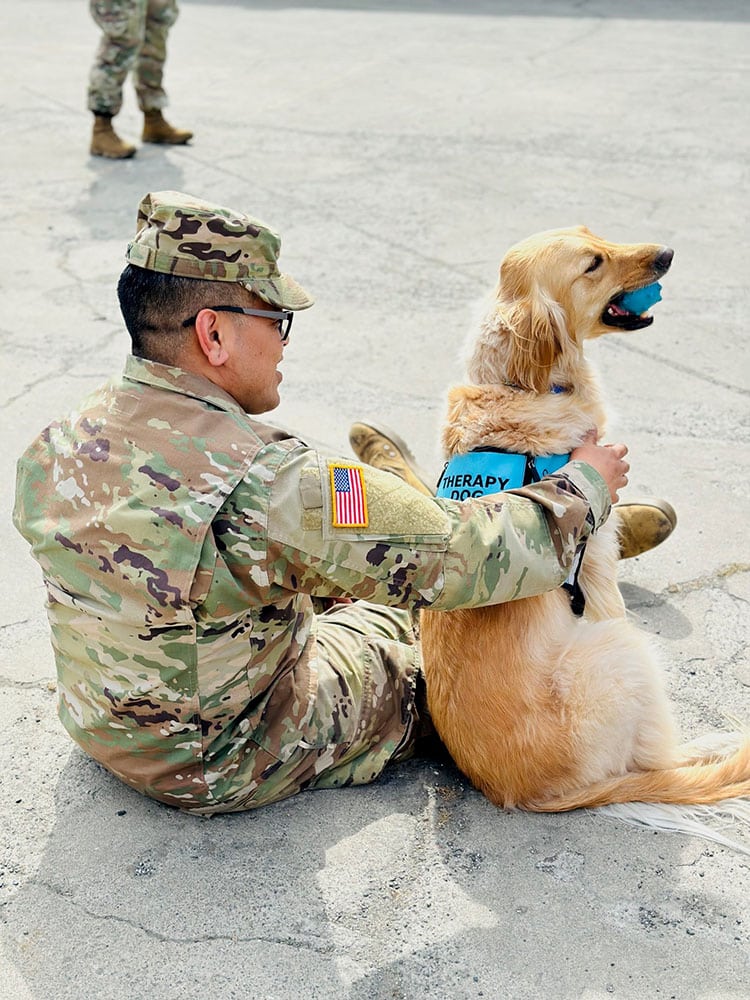
A person in army fatigues sits with a golden retriever in a teal therapy dog vestAt Canine Companions, we believe in the joyful, transformative power of the human-canine partnership – in every form!  More than one-third of dogs released from service dog training have gone on to serve as therapy dogs in their communities.  We think that’s incredible, and we are proud that through our therapy dog certification program, we can continue to support and engage volunteers while providing suitable released dogs with impactful jobs.

While our mission is to provide highly trained service dogs to people with disabilities, we believe that the incredible work therapy dogs do is an important extension of our core mission. With this program, we can exponentially increase our impact across the country.

What is a Therapy Dog? 

A therapy dog is a pet that accompanies their owner into specific settings for the benefit of the residents or clients in the setting and/or as part of a therapeutic intervention. 

Studies have shown that interacting with therapy dogs as part of an animal-assisted intervention approach yields both physical and psychological benefits to humans and the dogs. Our therapy dog program provides formal therapy dog certification for Canine Companions eligible teams in all regions.  

All Canine Companions dogs receive extensive temperamental and medical evaluations, and dogs selected for this program must be approved by our expert staff in both our national veterinary and training departments. Only a small number of dogs that qualify for the program will be available to those who didn’t raise the dogs as their volunteer puppy raisers. Our waitlist to adopt a release dog for therapy dog work is limited. 

The Canine Companions Therapy Dog Certification Program is an American Kennel Club (AKC) recognized program. Teams that are certified through this program are eligible to receive AKC Therapy Dog titles.
Watch: Bringing Paws-itivity - Therapy Dogs at Shepherd Center

Step into the world of Francisco, our amazing Canine Companions therapy dog, at the Shepherd Center in Atlanta. This furry hero is not just adorable; his calm demeanor and training allow him to spread happiness, comfort and calm wherever he goes throughout the facility.

Watch: Waves & Wags: Therapy Dogs Inspiring Moments on the Waves

Canine Companions therapy dog teams provide a wide range of support across communities, from providing emotional support to building confidence and enhancing life skills. These group of therapy dogs help wounded veterans and other people with disabilities catch waves and experience the thrill of the ocean, showing just how incredible the power of the human-canine bond truly is.

Volunteer Therapy Dog Certification

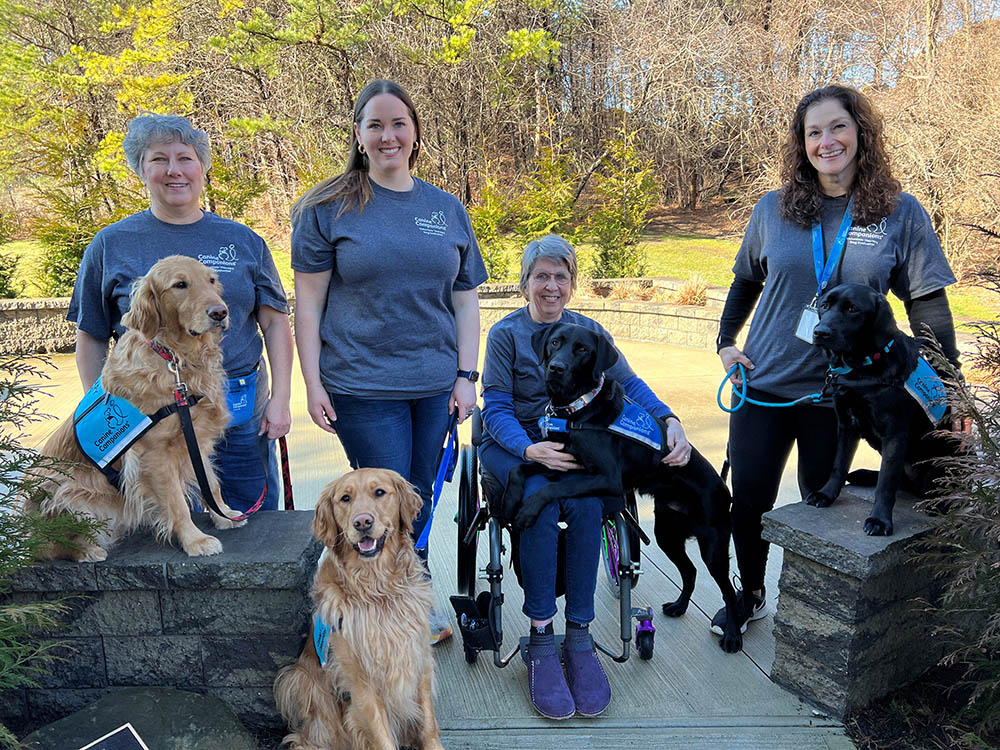
A group of smiling Canine Companions evaluators with therapy dogsTo be eligible for certification as a therapy dog handler, applicants must:

  • Live within the designated program area
  • Have an eligible Canine Companions bred dog whose temperament is appropriate for therapy dog work and are:
    • Released dogs over 1 year of age
    • Retired breeders
    • Retired Service or Facility dogs
    • Active male breeders, at least 6 months post-placement, with additional approval from the breeding and veterinary departments.
  • Complete coursework and examinations in preparation for certification.
  • Meet with a Canine Companions evaluator for in-person evaluations, including the Canine Good Citizen (AKC CGC®) test and a simulated visit. Participate in ongoing Canine Companions training and annual recertification through the therapy dog program that includes following the Canine Companions health criteria (see below FAQ: “Which dogs are eligible to participate in therapy dog work?”): 
  • Participate in ongoing Canine Companions training and annual recertification through the therapy dog program.
  • Demonstrate the ability to safely and effectively control, manage and care for the dog. 
  • Have adequate vision to observe, intervene, and manage a dog’s behavior.
  • Volunteer with their setting of choice or incorporate the therapy dog into their eligible professional work for a minimum of 24 hours per year.

Note: Some dogs may have conditions to their certification based on their release reasons that must be adhered to for the duration of their certification with us.

If you are interested in applying to be a Canine Companions therapy dog handler, please request and complate an application .
Volunteer Therapy Dog Evaluator Certification

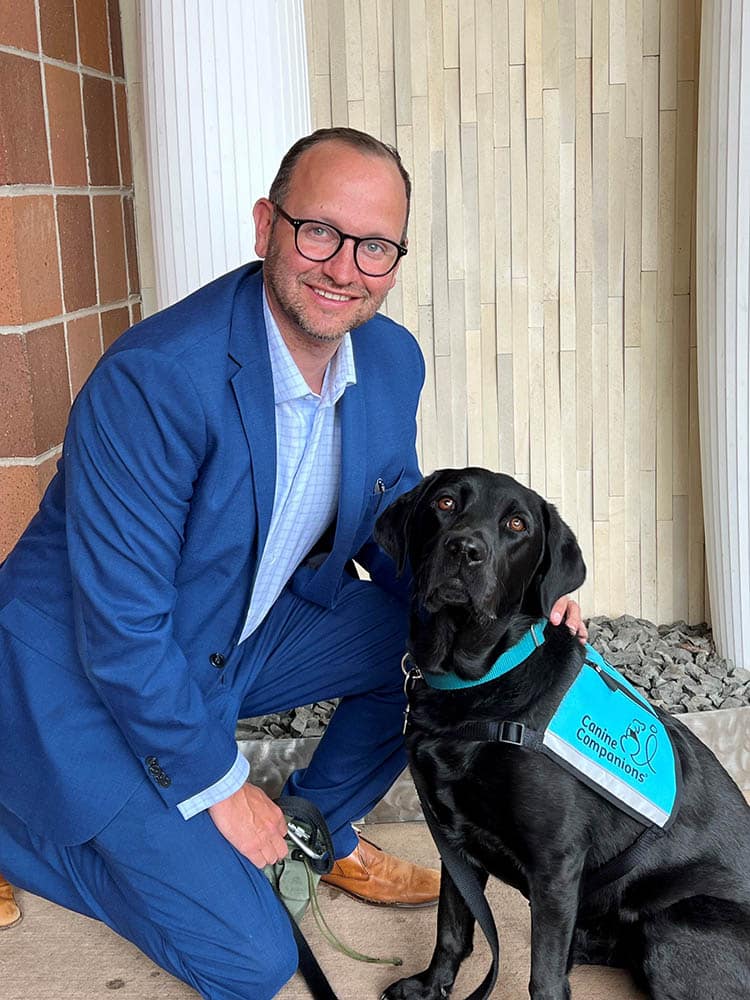
a smiling man a in a suit with his arm around a black lab in a teal therapy dog vestCanine Companions seeks eligible volunteers to administer the training and evaluation for therapy dog teams in the field.

To be eligible to volunteer as a therapy dog evaluator, applicants must:

  • Be a Canine Companions volunteer having completed the formal volunteer interview and volunteer onboarding process.
  • Have a documented minimum of 100 hours of experience as a therapy or are a facility dog handler with a Canine Companions dog.
  • Obtain and maintain active status as an AKC Canine Good Citizen (CGC)® Approved Evaluator.
  • Be familiar with therapy or facility dog settings.
  • Be willing to complete training specific to Canine Companions, including attending an in-person training course.

If you are interested in becoming a volunteer evaluator, please request an application.

Therapy Dog Adoption

Eligible released dogs (not adopted by their puppy raisers) will be available for placement with external applicants who are willing to make a five-year commitment to our therapy dog program. If you’re interested in adopting a therapy dog and agree to become certified within the first 12 months and commit to 5 years of active therapy dog certification with us,  please submit a request for an application here.

FAQs

Therapy dogs are invited in certain settings to increase the well-being of clients, residents, and students in places such as hospitals, schools, and nursing homes as well as in private therapy settings. The therapy dog is considered a pet dog and has no special public access rights.

Outside of approved facilities, bringing the therapy dog into public places where pet dogs are not normally allowed is against program policy. Canine Companions reserves the right to revoke the certification of any therapy dog handler found in violation of this policy.

No national standards exist for the training of therapy dogs; however, former New York Governor Andrew Mark Cuomo directed the commissioner of the department of agriculture and markets to convene a working group to examine the need for statewide standards for therapy dogs. We used their findings to guide the formation of our program. Canine Companions strives to hold our therapy dog program to a high standard of excellence despite the lack of national standards.

Dogs chosen for therapy dog teams have passed numerous behavioral and health screenings to ensure they are safe and comfortable around various people to whom they may provide comfort. All dogs participating in the program must be approved by our expert staff in both our national veterinary and training departments.

Handlers go through an application and interview process before being approved to participate in the program and must complete coursework and training specific to therapy dog work, including passing written and in-person examinations while working with Canine Companions staff and volunteer evaluators. They must demonstrate professionalism and be able to safely care for and manage the therapy dog in a variety of different settings and around different people. In all work, handlers are required to abide by Canine Companions’ Code of Ethics.

Finally, through our certification process, our therapy dog teams are AKC Canine Good Citizen certified and must demonstrate suitability through the practical examination.

As defined by the Americans with Disabilities Act (ADA), a service dog works for a handler with a disability and is individually trained to perform specific tasks that mitigate the symptoms of the person’s disability. Service dogs have public access rights, meaning that they’re permitted to accompany their handler who has disabilities anywhere that’s open to the public, even places that don’t permit pet dogs. 

In contrast, a therapy dog is a pet that accompanies their owner into specific settings for the benefit of the residents or clients in the setting and/or as part of a therapeutic intervention. Therapy dogs aren’t necessarily trained in specific tasks, nor are they working for the benefit of their handlers. Aside from specific settings where they have approval to perform therapy dog work, they may not be taken into public places where pet dogs aren’t permitted. Canine Companions vests and bandanas are only to be worn when doing therapy dog work. 

Facility dogs are expertly trained dogs who partner with facilitators working in a health care, criminal justice system or education setting. These dogs can perform up to 45 tasks designed to motivate and inspire clients with differing needs. Their facilitators are committed to long-term employment where they directly serve clients with special needs with a minimum of 20 hours per week. Facility dogs don’t have public access rights like service dogs do.
Our therapy dogs are required to have basic obedience skills and demonstrate safe and appropriate behavior in public. Therapy dogs are permitted to work a maximum of two hours per day and can be handled by a volunteer handler who brings their therapy dog to a facility, or by an employee of the facility who’s been certified as a therapy dog handler.
For more information about our facility dog program, please visit here

A therapy dog may provide comfort at a vaccine clinic, in a classroom, or for first responders. Depending on our dogs’ preferences and the clients’ needs, therapy dogs may sit or lie next to a client, read with them, take a walk with them, or play a game of fetch. A well-mannered and highly engaged therapy dog encourages feelings of calm and security for clients. There are many ways that therapy dogs help their clients!

There is a $100 initial certification fee and a $30 annual recertification fee. This fee includes liability insurance coverage and pays for the Canine Companions logo vest or bandana, issued at the time of certification. Canine Companions offers therapy dog teams support services free of charge.

For people adopting a therapy dog, there is a $3500 therapy dog adoption fee (waived for the puppy raiser of the dog). The same fees as above also apply at the time of certification.

Dogs that are eligible for the therapy dog program must be from Canine Companions.

Eligible types of dogs include:

  • Released dogs over 1 year of age
  • Retired breeders
  • Retired service and facility dogs
  • Active male breeders at least 6 months post-placement, with additional approval from the breeding and veterinary departments.

Due to health and safety concerns, active female breeders are not eligible to participate in this program. All dogs participating in the program must be approved by the veterinary and training departments as medically and temperamentally suitable for therapy dog work.


Health:
Dogs in the therapy dog program are required to be:

  • Up to date on five required vaccines (Rabies, Bordetella, Leptospirosis, DHPP/DH2PP and Canine Influenza) 
  • At a healthy weight  
  • On monthly preventatives
  • Receiving annual veterinary exams 
  • Have an annual fecal and heartworm test with negative results.  

These health criteria in the program are non-negotiable 


Temperament:
Dogs in the therapy dog program should be social, manageable, and appropriate for the setting(s) where they will be working. Dogs may have conditions to their certification based on their release reasons that must be adhered to for the duration of their certification with us. Examples are fear of children, surface sensitivity, and toileting concerns.

Because therapy dogs are working in approved professional settings providing therapy to the clients of the setting, if you are looking for a dog specifically for you, we encourage you to visit our website section Is a Dog Right for You? Here you can further explore our Service Dog program and the clients we serve, or you can reach out to your regional center location to inquire about our release dog program.

The therapy dog program is currently open in the following geographical areas in each region:

In the Northwest Region (Santa Rosa, CA):

Applicant distance: Open to the entire state of California, Oregon and Washington state. If you meet these requirements, click here for more information.

In the Southwest Region (Oceanside, CA):

Applicant distance: The entire Southwest Region is open to the therapy dog program. Serving Arizona, Utah, Colorado, New Mexico, Southern California, Southern Nevada and Hawaii. If you meet these requirements, click here for more information.

In the South Central Region (Irving, TX):

Applicant distance: The states of Texas and Louisiana. If you meet these requirements, click here for more information.

In the North Central Region (New Albany, OH):

Applicant distance: The entire North Central Region is open to the therapy dog program. Serving Ohio, Kentucky, Michigan, Indiana, Illinois, Wisconsin, Missouri, Iowa, Minnesota, Kansas, Nebraska, North Dakota, South Dakota and Western Pennsylvania. If you meet these requirements, click here for more information.

In the Northeast Region (Medford, NY) :

Applicant distance: open to all of New York and New Jersey, West Virginia, Virginia, Delaware, Pennsylvania, Rhode Island, Maryland, and Maine. If you meet these requirements, click here for more information.

In the Southeast Region (Orlando, FL):

Applicant distance: 150 miles from the Orlando, FL campus (8150 Clarcona Ocoee Rd, Orlando, FL 32818), and completely North from the Regional campus to the Florida Panhandle. The states of Georgia, Alabama, Tennessee, and Mississippi. If you meet these requirements, click here for more information.

Canine Companions makes therapy dog certification available to owners/guardians of eligible dogs (see Eligibility). Handlers may be certified with other therapy dog organizations, but should be aware that other organizations may not permit dual certification.

We recognize that individual programs and facilities may have policies that prevent the Canine Companions therapy dog certification program from being the best fit.

If you have any specific questions, please contact the closest region.


Therapy Dog Program Team Members

  • Caitlin Bradley – Therapy Dog Program Manager 
  • Lisa Marcolongo – Therapy Dog Program Coordinator 
  • Megan McWilliams – Therapy Dog Program Coordinator 
  • TBD – Therapy Dog Program Coordinator