
Home » Service Dogs » Our Dogs » Medical Alert Dogs
Medical Alert Dogs
Get Involved
- Dog Grooming & Walking
- Foster Home or Puppy Raising
- Administrative Support
- Facility Maintenance
- Photography or Videography
How to Apply for a Medical Alert Dog
The medical alert dog application window runs from January 1- April 30 each year. All applications received during this time will be reviewed in May and June. From there, applicants will be contacted for follow up questions and further evaluations. Applicants will be notified by email/snail mail about decisions by the end of August.
To learn if you are eligible to receive a medical alert dog, please reference the FAQ section below:
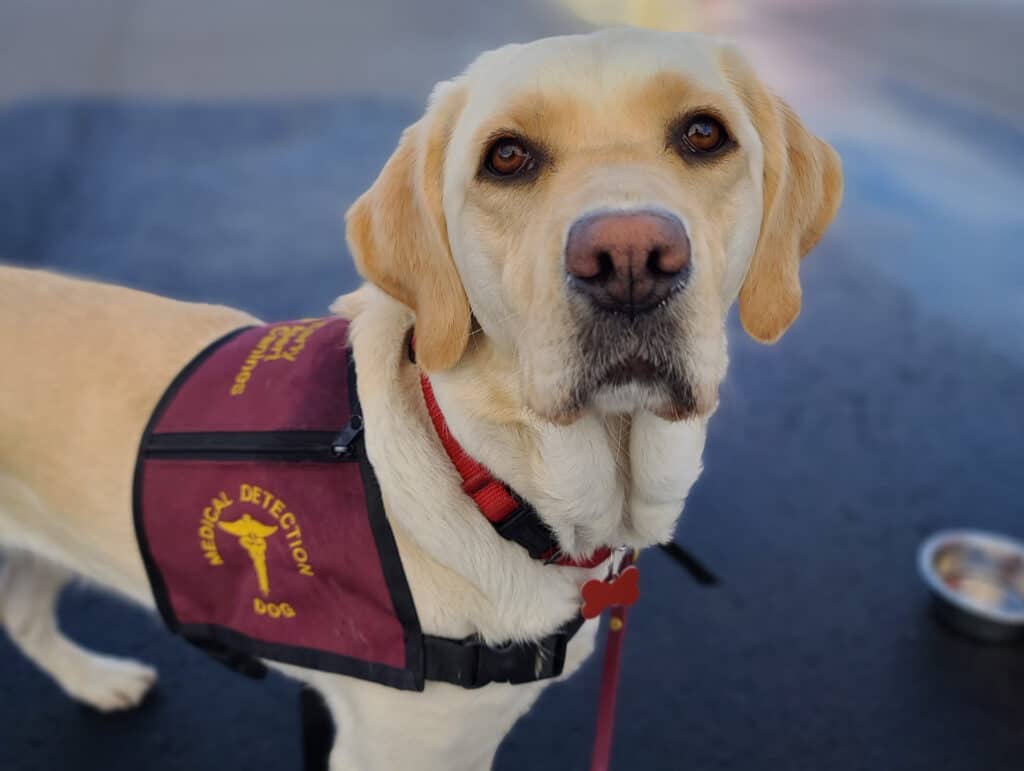
Our dogs alert individuals with diabetes when they detect low or rapidly dropping blood glucose levels. Using their exceptional sense of smell, these dogs provide early warnings that help prevent dangerously low blood glucose levels.
Participants in our program use a standard glucose meter to confirm the dog’s alert and then take appropriate actions to manage their blood sugar levels. Prompt treatment of low glucose episodes not only enhances safety but also improves overall blood glucose control and can be life-saving.
Positive reinforcement is the foundation of our training approach. When a blood glucose test confirms a dog’s alert, the dog is rewarded with treats, enthusiastic praise, and/or playtime.
We carefully select dogs for training based on their strong desire to work with humans. For these dogs, detecting and alerting to low blood sugar becomes an engaging game that earns them rewards. Our training team collaborates closely with clients to ensure that rewards are given effectively, enhancing the dog’s alerting capabilities.
Working with a diabetic alert dog is a lifelong commitment, and consistent, appropriate reinforcement is crucial for sustained success and effectiveness.
Under the Americans with Disabilities Act (ADA), employers are required to provide “reasonable accommodations” for employees with disabilities. In many cases, a blood sugar alert dog qualifies as a reasonable accommodation, offering valuable support in various work environments.
However, the suitability of a service dog depends on the specific work setting. For instance, a busy commercial kitchen with hot pans and boiling pots might present challenges in justifying a service dog as a reasonable accommodation. Each work environment needs individual assessment to determine if a service dog can be safely integrated.
Diabetic alert dogs have successfully been integrated into various professions, including teaching, technical roles, nursing, and office work. However, not all situations may qualify as “reasonable accommodations.” Canine Companions is committed to assisting both current and prospective clients in evaluating whether a service dog is the right fit for their unique work environment. We are here to help you assess your specific situation and determine the best solution.
Our medical alert dogs are highly trained for accuracy, but it’s important to remember that they are not infallible. While these dogs offer valuable support, they are not perfect and may occasionally miss some low blood sugar events. Therefore, medical alert dogs should be used as an important supplementary tool alongside your regular blood sugar management methods.
These dogs excel in detecting rapidly changing blood glucose levels, and successful use relies on ongoing collaboration with Canine Companions staff. Regular follow-up is crucial to maximize the effectiveness of your alert dog.
The person with diabetes must also be highly attentive and engaged in their partnership with the medical alert dog. While a newly placed dog may start with an accuracy rate of around 60%, consistent training and adherence to Canine Companions guidelines can improve this rate to over 90% within a few months.
Eligibility Criteria
To be considered for a medical alert dog with our program, you must have insulin-dependent diabetes, have been using insulin therapy for at least one year and a resident of the United States. Ideal candidates are those who diligently manage their diabetes. Our dogs are not suited for individuals who are not actively working to control their condition. If you need support to enhance your diabetes management, please visit our resources page or contact us for additional help.
Costs
All Canine Companions service dogs are provided at no cost to the recipient. Training a medical alert dog and providing ongoing support for its lifetime costs upwards of $50,000. However, we are committed to making this life-saving support accessible by minimizing costs. We are able to place our dogs free of charge thanks to our large support system of volunteers, donors, and partners.
Essentially, all of these terms are correct, but it’s important to distinguish between two key aspects: dogs that assist people with diabetes and dogs that themselves have diabetes.
At Canine Companions, we focus exclusively on training dogs that support individuals with diabetes. We do not train dogs with diabetes or other serious medical conditions.
For more information on canine diabetes and its symptoms, please consult with a veterinarian.
Location
Our office is currently located at 1641 Challenge Dr #300, Concord, CA 94520.
NOTE: We will be moving to our new office in the beginning of May. Our new address is: 4090 Nelson Ave, Suite C, Concord CA 94520.
*Please be aware that by clicking these links — you are visiting sites that are not managed by Canine Companions. Website security, accessibility and privacy policies may be different than Canine Companions policies. Please read their policies closely.